
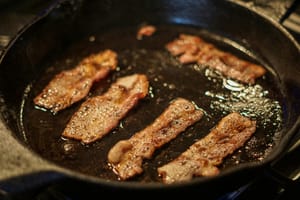
I got thinking about bacon grease the other day.
I’m not entirely sure why. That’s one of the things that happens as you get older. At 25 you think about where you’re going Friday night. Eventually you find yourself wondering why your mom or grandmother kept a coffee can full of pig fat sitting next to the stove.
And nobody thought this was strange.
She’d fry bacon, take the bacon out of the pan, and then carefully pour what was left into a can or jar like she’d just struck oil in the backyard.
Because, apparently, she had.
Throw bacon grease away? Are you crazy? There was perfectly good grease in there.
I remember those cans sitting around kitchens when I was growing up. Sometimes it was an old coffee can. Sometimes somebody had the fancy version—a metal container with a little strainer in the top made specifically for saving grease.
I don’t remember anybody checking an expiration date.
I’m pretty sure bacon grease didn’t know it was supposed to have one.
You just kept adding to it.
Which got me wondering why everybody saved the stuff in the first place. Was it just one of those things people did because their mother did it, who did it because her mother did it?
Turns out there was a pretty good reason.
Cooking fat used to be valuable.
Before we had an entire grocery-store aisle filled with vegetable oil, canola oil, olive oil, avocado oil, coconut oil and probably some kind of oil squeezed from a Himalayan berry that costs $17.95 for six ounces, people used what they had.
And what they had quite often came from the pig.
Rendered pork fat was used for cooking all kinds of things. If you had just cooked bacon and there was perfectly good fat left in the skillet, throwing it away would have seemed ridiculous.
It would be a little like buying a gallon of gasoline, using half of it and dumping the rest in the ditch.
Although apparently that analogy worked better before gasoline got expensive enough that somebody might actually tackle you before you reached the ditch.
So Grandma saved the grease.
Then the food business started changing.
Crisco showed up in the early 1900s, vegetable oils became common, supermarkets came along and eventually Americans had plenty of inexpensive cooking fats that didn’t require keeping a coffee can beside the stove.
Animal fat started looking old-fashioned.
My Grandma and her daughter apparently didn’t get the memo.
Because they knew something else.
Bacon grease tastes good.
That may not be the scientific breakthrough CENTERLINE becomes famous for, but I’m willing to stand behind it.
Fry potatoes in a little bacon grease and tell me I’m wrong.
Green beans? Absolutely.
Gravy? Now we’re talking.
Cornbread?
Grandma just pulled up a chair.
Bacon grease isn’t simply fat. It brings some of that smoky, salty bacon flavor along with it, which is probably why people who actually know how to cook have never completely stopped using the stuff.
And here’s the funny part.
After spending decades getting animal fats out of our kitchens, we’ve started bringing them back.
Duck fat is fancy now. Beef tallow is showing up again. People cook with schmaltz. Restaurants brag about potatoes fried in animal fat.
And bacon grease?
Save it.
Apparently Mom and Grandma weren’t behind the times.
We just had to spend about 70 years getting smart enough to catch back up with them.
Now, before somebody fills a five-gallon bucket with bacon grease and lists CENTERLINE as their medical reference, I’m not suggesting we replace everything in the kitchen with bacon drippings.
Grandma probably wasn’t drinking it through a straw either.
But I think there was something bigger hiding in that little can beside the stove.
Those old kitchens didn’t waste much.
A chicken could become several meals. The bones could become stock. Leftover bread became something else. Jars got reused. Coffee cans apparently entered a second career holding everything from bacon grease to nails, screws and whatever mysterious collection of hardware Grandpa was absolutely certain he would need someday.
And eventually he usually did.
Nobody called any of this sustainable living.
There wasn’t a movement.
Nobody made a documentary about Grandma reusing a pickle jar.
They just didn’t throw perfectly good stuff away.
Somewhere along the way, convenience changed that. We got pretty good at using something once, throwing it away and buying another one. In many ways life got easier because of it.
But every once in a while you run across one of those old habits and realize maybe the people before us weren’t doing it because they didn’t know any better.
Maybe they knew something we forgot.
So I’m beginning to think my Mom’s and Grandma’s little grease can deserves an apology.
Although if we’re bringing it back, I’m drawing the line at keeping it beside the stove for fourteen years.
There are some family traditions that don’t need quite that much authenticity.